

Okay, so check this out—prediction markets feel like a weird mashup of Las Vegas odds and academic forecasting. Wow. My first brush with them was messy: I clicked into a platform, felt the buzz, then froze because the UX was chaotic and the jargon hit me like a cold snap. Seriously? But stick with me. There’s a practical, almost gritty case for why decentralized prediction markets matter for markets, governance, and real-world decision-making.
My instinct said these markets are niche, for tinkerers and token speculators. Initially I thought they’d stay that way. Then I watched a few events unfold where prices moved ahead of mainstream news—sometimes by hours, sometimes by days. Hmm… that changed my view a bit. On the one hand they’re tools for speculation and hedging; on the other, they’re real-time aggregators of collective belief, and that has downstream value for traders, researchers, and even policymakers.
Here’s the thing. Decentralization isn’t just a buzzword. It reduces censorship risk, preserves access for diverse participants, and, importantly, creates permissionless markets where unexpected information can surface. But actually building markets that attract diverse, liquidity-rich participation—well, that’s the hard part. It’s not enough to be open. Depth, incentives, and a decent UX matter more than most founders admit.
Let me give a quick, informal tour of what’s going on and how you can jump in without getting wrecked.
First: why people use them. Short answer: information and leverage. Medium answer: traders use prediction markets to express probability beliefs in a tradable way—convert a hunch into a price. Long answer: institutions can use them to hedge exposure to event outcomes (policy decisions, product launches, macro indicators) and researchers can use aggregated probabilities as features in forecasting models, which then feed investment strategies or risk models.

Practical guide: getting started (no fluff)
Start small. Really small. Your first trade isn’t a moral statement, it’s a learning exercise.
Find a market with decent volume and a clear event definition. That single step removes a lot of accidental losses. If the event wording is fuzzy, the settlement will be, too—leading to disputes and frozen funds.
Want a safe on-ramp? Consider established protocols and interfaces. If you’re looking for a specific entry point, I’ve bookmarked a useful access page: polymarket official site login. It’s not an endorsement of any one strategy—just a practical pointer to a place where markets live and breathe.
How to size a position: think in probabilities, not in hopes. Convert your belief into an implied probability and size the bet so you’re comfortable being wrong. This sounds obvious, but people very often overbet on feelings. My personality biases show here—I’m biased toward risk control because I’ve seen good thesis positions wrecked by single-event surprises.
Liquidity matters. Two things drive it: participant diversity and maker incentives. Automated market makers (AMMs) help when human liquidity is thin, but their parameters matter. Fee schedules too. If fees are too high, only toxic flow shows up; if fees are too low, markets aren’t sustainable. On-chain AMMs add transparency but also on-chain constraints—gas, oracle timing, and front-running vectors.
Oracles are the backbone. If the oracle is slow, manipulable, or opaque, the whole market’s trust collapses. On-chain oracles, decentralized attestations, and multi-source settlement mechanisms mitigate risk—but they add complexity. So there’s a trade-off: simplicity vs. resilience.
One more operational note: watch settlement rules. Payout mechanics, deadlines, and dispute windows can trap funds in ambiguous states. I once watched a market where the wording allowed two plausible settlement interpretations—ugh. That part bugs me. Always read the fine print.
When decentralized prediction markets outcompete centralized ones
Short version: when censorship-resistance and composability matter. Medium: when markets are used as infrastructure—feeding DAOs, hedging protocols, or algorithmic strategies. Long: when you need permissionless access to instruments that can be integrated into smart contracts, automated treasuries, or derivative stacks, decentralized markets win because you can program payouts into on-chain logic.
Consider a DAO that wants to hedge the risk of a key vote failing. It can source a prediction market’s price to trigger insurance payouts automatically. That’s neat. But it’s also fraught: oracles must be secure, and players can try to manipulate low-liquidity markets to trigger undeserved payouts. So the DAO needs to weigh cost vs. trust—sometimes paying for robust data is worth it.
Also—regulation. Yeah, this is sticky. Some jurisdictions treat prediction markets as gambling, others as financial derivatives. Decentralized platforms can’t hide from regulation forever; they just change the attack surface. Expect enforcement to target central points—wallet providers, fiat on-ramps, oracles, and governance teams. On the other hand, distributed governance models can make single-target takedowns harder, which preserves functionality for participants in restrictive environments.
Common questions (and short, candid answers)
Are prediction markets legal?
It depends. Jurisdiction matters. Many US states have unclear rules; federal law treats different products differently. I’m not a lawyer—do consult one if you’re building big, but for small personal trades most users fall into a gray area. Caveat emptor.
Can prices be manipulated?
Yes. Especially in low-liquidity markets. Manipulation is costed—if an attacker can profit from the manipulation net of costs, they’ll try. Watch liquidity depth and the identities (or pseudonyms) of big players. Also, thoughtful settlement design can deter cheap manipulation.
How do oracles work here?
Oracles ingest real-world outcomes and push them on-chain. Designs range from trusted reporters to decentralized attestation-by-many. The more distributed the oracle, the more expensive and slower—but generally the more reliable. Choose based on the stakes.
On a tactical level, here’s a quick checklist before you trade: confirm event wording, check volume and spread, read settlement and fee rules, verify oracle design, and size the trade to your risk tolerance. It’s boring, but that checklist saves you from the dumb mistakes that cost real money.
One thing I haven’t solved personally: how to sustainably bootstrap long-term liquidity for low-frequency, high-value events (think major policy outcomes). I have some ideas—subsidized liquidity mining, staking insurance pools, and partnerships with institutional hedgers—but none are silver bullets. Somethin’ to iterate on.
Okay, final thought. Decentralized prediction markets are both a mirror and a microphone for collective belief. They amplify conviction and expose uncertainty. If you approach them with humility, a rules-first mindset, and discipline, they’re remarkably useful. If not—well, markets will humble you, and fast.
Still curious? Try a cautious exploration—start with a small position, track outcomes, and ask why a price moved. That’s where the learning lives. And if you want the practical login path to one of the active platforms, see the polymarket official site login link I mentioned earlier—again, just a pointer to get you into markets faster.
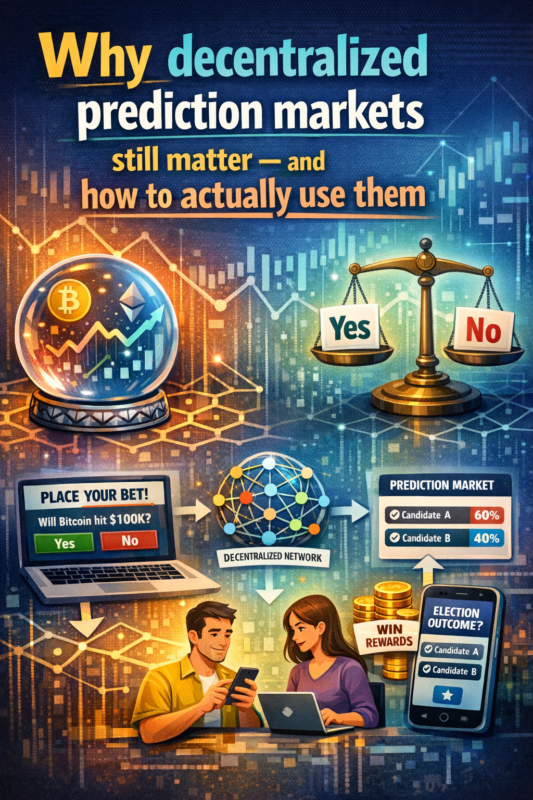
Why decentralized prediction markets still matter — and how to actually use them